Germany 1937 Colorized
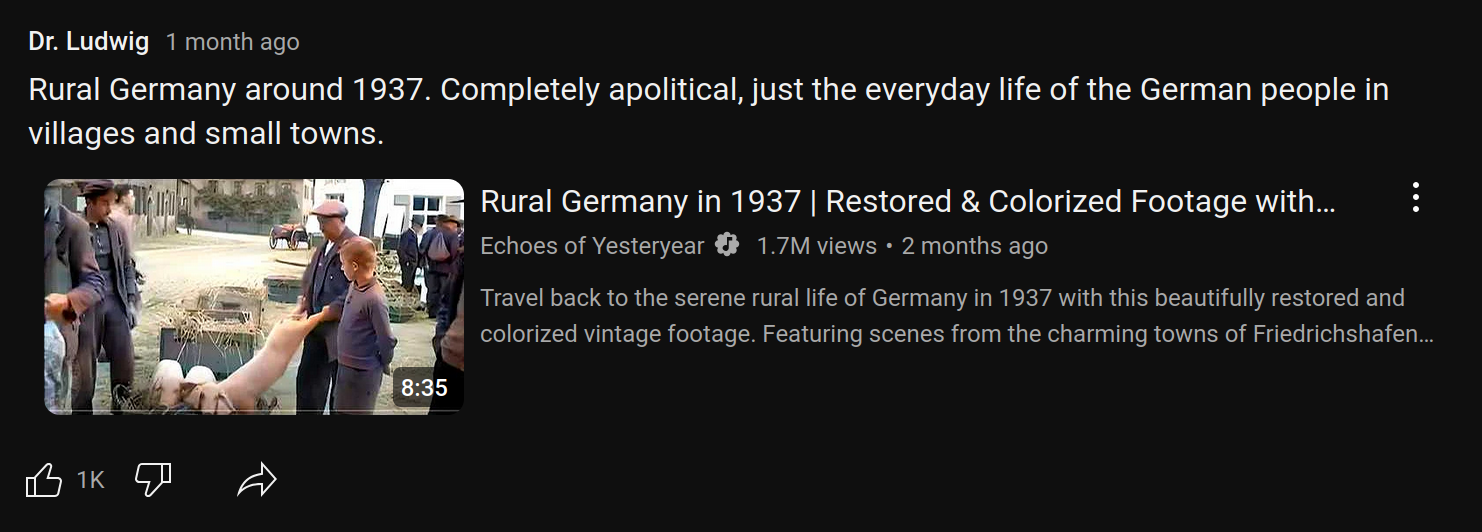
God knows why, but I sometimes get nostalgia content in my algorithmic feeds, YouTube has been especially eager for me to look at footage from 100 years ago, interviews with people born in the 19th century and what not. Occasionally there’s more overt Nazi propaganda in there, up to Wehrmacht apologia and weird Nazi occultism. So I wasn’t particularly surprised when recently YouTube recommended me to watch a clip titled Rural Germany in 1937 | Restored & Colorized Footage with Added Ambient Sound. Usually I try not to interact with these videos – I don’t want to encourage the algorithmic gods – but this one caught my attention, maybe it’s just the current state of the world.
The video now has about 1.7 million views and is a nine minute collage of scenes from everyday life in rural 1937s Germany, we see a market, women buying apples, men buying pigs. People working in fields, herding cattle, tending to horses. A woman looking out of the window while petting her cat – you get the picture.
The description frames the video as nostalgic evidence of a simpler time:
Travel back to the serene rural life of Germany in 1937 with this beautifully restored and colorized vintage footage. Featuring scenes from the charming towns of Friedrichshafen and Dinkelsbühl, this video captures the nostalgic essence of a simpler time.
Watch as locals go about their day in traditional attire, showcasing crafts, agriculture, livestock, and open-air markets. The picturesque German countryside, with its distinctive rural architecture and timeless traditions, comes alive with the addition of carefully designed ambient sound, immersing you in the peaceful rhythm of village life.
This rare glimpse into history highlights the cultural richness and tranquility of rural Germany in the 1930s. Perfect for history buffs, fans of vintage aesthetics, and anyone seeking to experience the beauty of a bygone era.
Leaving aside that it calls a janky AI job “beautifully restored and colorized”, the video itself does a decent job in delivering what’s promised, the color and ambient noise produce a sense of immediacy, as one commenter notes:
Klasse das es in Farbe ist. Die alten s/w Dokus sind mir immer sehr fremd bzw. kann da nicht eintauchen. Gerne mehr davon.
Great that it’s in color. The old b/w documentaries are always very foreign to me, I can’t immerse myself in them. I’d love to see more. (my trans.)
Most comments under the video are in a similar vein. Telling stories of relatives who spoke about the kind of life on display in the clips, recounting their own experience of rural Germany, revelling in “the cultural richness and tranquility of rural Germany in the 1930” as the video description puts it.
There’s an obvious wrinkle in the image of the good old times here: In 1937 the Nazis had been in charge for four years and thoroughly consolidated their power in the institutions and civil society. Political enemies of the Nazis were already deported to concentration camps, Jews, Romani, Black, disabled and queer people faced legal persecution and exclusion from society. There’s no space for all that in the image of ordinary life painted by the video, nor in the comment section.
Yet the Nazis are by no means absent from the discussion. A number of comments talk about how two years later catastrophe would strike and end these glorious times. One commenter bemoans the young’uns from the video probably being used as cannon fodder just a few years later, another diagnoses “the right wing” being responsible for this worlds demise. What’s striking is that in all these comments the catastrophe is positioned chronologically after the time of the video. The whole comment section is quite evocative of Aimé Césaire’s famous dictum that Europe could never forgive Hitler the humiliation of the European white man. Not the Jews, not the Queers, not the Romani are treated as the victims here: The real victims seem to be the innocence, the tranquility and cultural richness of rural Germany and “all European villages from Normandy to the Urals” as one commenter says. Quite explicitly the catastrophe is understood to be the destruction of a prelapsarian Europe by the second World War.
It seems a striking exhibition of how life goes on, how you can live under a fascist regime, even during a genocide and just go on with your life as long as you yourself are not personally targeted. The market is still open, you still need to eat and pay rent and the apples are as sweet as ever. Even worse: It’s a demonstration how, by keeping death just out of view, you can even make life in fascism a nostalgic utopia for people who should be aware of what Germany in 1937 was. The year is not hidden, the Nazis are just out of frame – literally.
The footage in the video is taken from recordings by Julien Bryan, who in 1937 spent seven weeks in Germany. There he filmed Germans going about their day, very consciously capturing and making explicit the ways in which Nazism was ever present in civil society; swastika flags, shops and doctors advertising to be true Aryans, others being marked as Jewish and people interacting with SS officers, children being part of the Nazis’ youth organisations, exhibitions of ‘Degenerate Art’.1
Watching the unedited footage it’s clear that the YouTube video was very carefully edited to omit all signs of Nazism. Sometimes it’s just the omission of that one camera angle in which the swastika in the background is in full view. As I said: The Nazis are just out of frame. To construct a nostalgic image of everyday life in 1937 Germany evidently involves more than some sloppy AI colorization: It requires an active effort of repression of how interwoven the genocidal element of German society was with the tranquil village life we’re seeing. This necessity is instructive in another way: It also hides the fact that, yes life goes on, even under fascism – if you’re not targeted – but it requires a commitment to not see the catastrophe all around you, just as the ordinary day on the market required to not be bothered by swastikas and doctors advertising to be Aryan.
In 1938 Bryan’s footage was used in the March of Time newsreel Inside Nazi Germany, which is itself noteworthy for its historical role in the development of documentary film as a medium for political agitation (Fielding 1959). In 2003 Bryan’s footage was acquired by the United States Holocaust Memorial Museum’s Steven Spielberg Film and Video Archive who provide online access to most of the material.
People might not believe my story if I told it in words when I returned to America. Everyone would believe my pictures. (Julien Bryan)
The quote is probably about Bryan’s later work, documenting the German invasion of Poland. It wasn’t quite that easy to get an anti-fascist effect out of the material of 1937, apparently quite a few of his American contemporaries thought the footage of well nourished youth and well groomed soldiers made Nazi Germany quite attractive (Fielding 1959), after all the footage was produced with Nazi approval. The contestation of the meaning of the images is not new, although the very deliberate editing, not even just decontextualizing the images but omitting an integral part of what Bryan was attempting to capture, certainly adds another layer of repression to the construction of the nostalgic past.
The insidiousness here lies in the construction of a normality that makes it easy to ignore the death just out of frame. The video doesn’t show the Nazis, it paints a romanticized picture of rural life that invites engagement as just that, you could criticize the image of rural life in the first half of the 20th century on those grounds, in fact this sentiment is much more prevalent in the comments to the video than any acknowledgement of its Nazi context. Yet this critique, while generally worthwhile, is missing the point: It accepts the frame that Germany in 1937 is a place like any other, one that can be depicted without engagement with the ongoing preparations of the Holocaust and the repression already in place. The video could have been presented without giving a year, which is really the only evidence of the context given, but it wasn’t; the video could’ve included the explicit Nazi insignia present in the source material, but it doesn’t. The effect is the depoliticization of everyday life under fascism.
References⌗
-
A compilation of Bryan’s work that contains all the footage used in the YouTube Video including a time stamped index can be found on archive-akh.de. The material is also available in the online archive of the United States Holocaust Memorial Museum’s Steven Spielberg Film and Video Archive, although there the footage used in the YouTube video is spread over a range of shorter segments. ↩︎